
Oliver Bly Takes Us To the Woodland Kingdom to Chat About Their Debut Graphic Novel, The Mushroom Knight
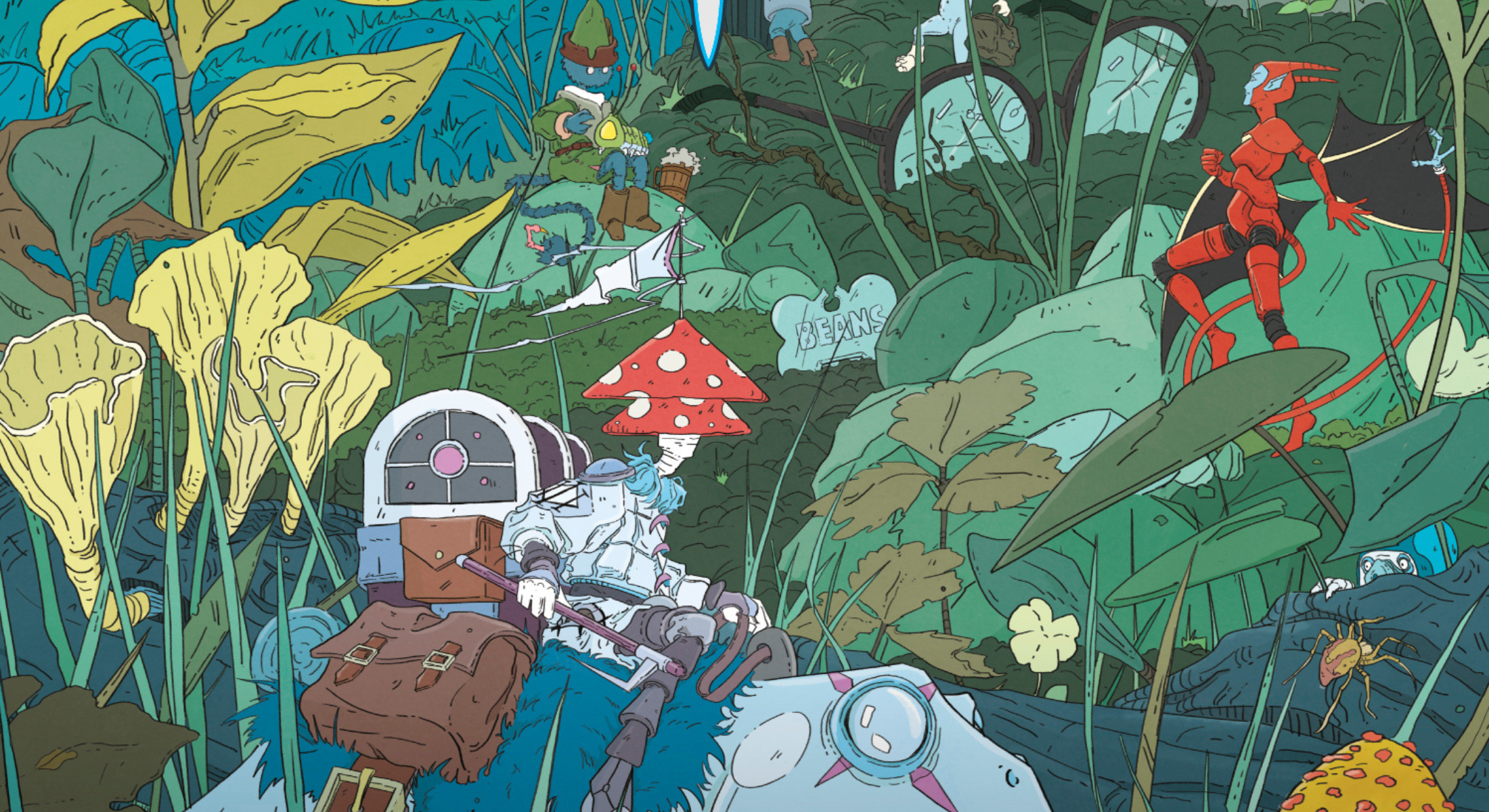
Oliver Bly is a cartoonist, mycology enthusiast, and invasive Philadelphian currently residing in Western Washington. His debut graphic novel, The Mushroom Knight, is an ontological urban faerie tale that explores the ecology of our day from a variety of perspectives—some plant, some animal, some human-animal, and some… decidedly none of the above.
The graphic novel is available now through Mad Cave Studios and you can find it on digital platforms and your favorite local comic shop.

The Mushroom Knight follows a chivalrous faerie mushroom that embarks on a quest to uncover a clandestine threat that has brought calamity to his magical woodland kingdom. An adolescent girl from northwest Philadelphia desperately searches for her lost dog. As their destinies coalesce, a whimsical friendship forms. But peril is nigh, and their respective journeys threaten to challenge the foundation of their realities… and reality itself.
We had the opportunity to speak with Bly about their debut graphic novel and the fantasy adventure they have crafted. Check it out below and be sure to join the magical woodland kingdom.
What sparked the initial idea for “The Mushroom Knight,” and how did it evolve during the creative process?
I’m from Philadelphia, and at the time I was living next to The Wissahickon Valley Park, which is a sprawling preserve encompassing over 2,000 acres of woodland, framing the North Western area of the city.
It is a really special place with its own stories, characters, and fascinating history. And since it’s so close to the city itself, you can really see the tension between the way humans have transformed the land, and the way the land may once have been, even though The Wiss itself has been very transformed by human interaction.
Cultures from all over the world have stories of little diminutive magical people, that are often associated with the wilderness in someway, whether you call them faeries, pixies, gnomes, anjanas, lutins, siyawesi, tomte, or memegwaans, they keep showing up.
So the idea was—what if these creatures were real, and there really was an overlapping “Otherworld” or “spirit world” layered on top of ours? And specifically, over Philadelphia?
At the same time, I’m really interested in a lot of -ologies and how they overlap. Mycology, ecology, and psychology, sort of scientifically looking at the natural world and the world of human consciousness inside the natural world, because they are pieces of the same puzzle.
So I wanted to tell a story about science and spirituality, of how humans think and feel and how that relates to how we treat the rest of the Tower of Life, of which we are only a piece.
I wanted to treat these fantastic creatures with a grounded, scientific lens, kind of looking at fantasy through the lens of reality. I wanted to explore their cultures and civilizations, their politics and their ways of organizing. And I thought—if these kingdoms of gnomes and elves actually exist, what would be their conflict?
There would be trolls, and goblins and the like, but what about us? What would they make of the human problem? What is their answer to the anthropocene?
From the human side of things, I thought starting with someone youngish, maybe 12-13 years old, would be appropriate, because it is a time of transformation and coagulation. As your body changes, the door between adulthood and childhood closes.
We link childhood to fantasy, and adulthood to reality, but children are incredibly aware and afraid of the treacheries of the real world, and it is sometimes adults who live in dreams.
That this kid, this girl from gritty, beautiful, soberingly-real Philadelphia would be our link to the world of the fae, would be the bridge between fantasy and reality, the transcendent and the mundane—that just made intuitive sense to me.
So that’s where you’ll find The Mushroom Knight, somewhere between The Smurfs and The Wire. Between the scientific and the spiritual, the magic and the street trash, the city and the woods. In those tensions, the idea grew and evolved.

Can you share some insights into your artistic choices, particularly in character design and the visual representation of the Mushroom Knight’s world?
For sure. There’s this kind of Neil Gaiman-ish idea around the faerie creatures in the book, and it’s that they might appear differently to different people in different cultures throughout time. Like how Morpheus’ appearance in The Sandman would adapt to the eye of whoever beheld him, but there were certain stylistic tells that he brought with him across adaptations.
We meet the gnomes in the book, who I call Gödels (after the mathematician,) in proximity to Lem, the adolescent girl, so I wanted some of the character design to reflect her perspective, which would have been colored by the media she’d have consumed through her childhood in the 90’s, things like Garfield, Snoopy, old cartoons and comic strips.
But additionally, I wanted them to allude to something older, ancient, and maybe not of this world. These are complex beings from a different layer of reality, and maybe they only look like this because our brains are using visual metaphor to relate to them.
Kind of like how in the bible angels are not coded as attractive people with feathery wings, but are instead revealed in impossible and abstract forms. Yet when we see an attractive person in a gown with feathery wings, we think “ah, an angel.”
So here we have “ah, a mushroom gnome.” But what the heck is this thing, really? I want to ask that question in the designs. There are ancient rock paintings and carvings from different parts of the world that feature mushroom headed or inhuman beings that resemble some of the character designs in the book.
The Gödels in The Mushroom Knight have been related to humans for a long time, and while the similarities here may be coincidental, I like to think of them as evidence.
I like to thematically layer meaning into character designs. For instance, you can look at Grekin and Pasume. Grekin is a type of furry gnome whose face is mostly obscured by hair. Pasume is a “snooterpillar”, a fictitious caterpillar, and is sort of Grekin’s animal companion/best friend. As friends, they depend on each other. When you look at Grekin’s face, he has these big saucer-like eyes that can see in the dark, but he is lacking a nose and a mouth.
Pasume has no eyes, but she has a large nose and a mouth that can become quite large. Both are overcompensating for the features they lack, like people will do, internally. But together they create an entire face. Together they are a team, and can engage the world with power.
So you see these two and you might not consciously pick up that their complimentary facial features link them intrinsically, but of course, a part of you, the magical part of you, totally gets it.
Now look at Gowlitrot and Lem. Lem has all her facial features, she looks normal on the surface, and can communicate and engage with the rest of humanity with her facade. But her inner self is mysterious, who she really is and who she will be, her true uniqueness and potential is hidden. She’s afraid to show people who she is on the inside. It’s a mystery to her, too.
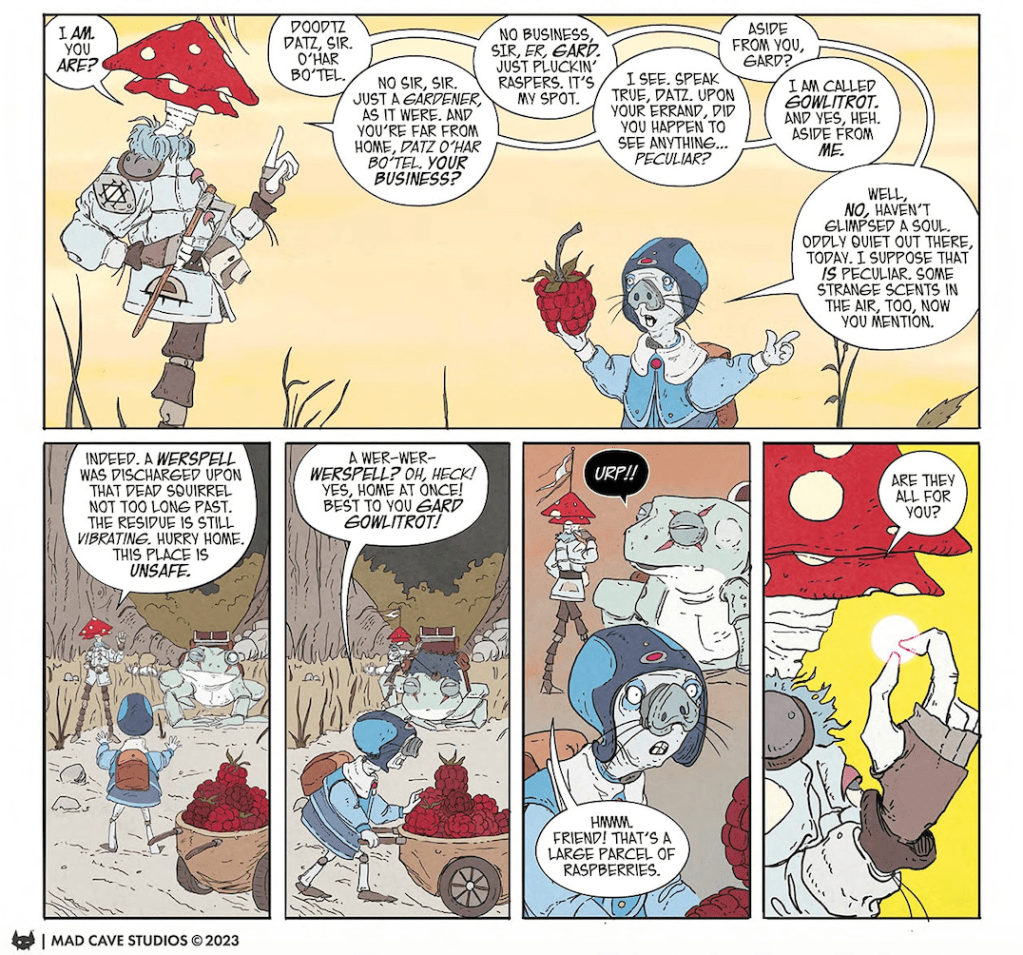
On the other hand, Gowlitrot keeps his physical face concealed through wrappings. He dresses in esoteric armor, he is covered in sigils. His outside identity is a mystery. He needs Lem to help him interact with the surface world of humanity, he needs her to be his “face”.
We don’t really know what this thing is, and I’ll tell you honestly—he’s not just a little mushroom cartoon. He’s much, much more. And similar to Grekin and Pasume, Lem and Gowli make a team. Together their designs balance.
What challenges did you face while bringing The Mushroom Knight to life, and how did you overcome them?
Alan Moore said “Beauty is easily imagined but its realization will require a greater faculty, requiring long yards of golden toil.” And I agree with that. The first challenge is always making the thing, and maintaining belief in the idea and yourself while you toil, finding the energy to push through exhaustion.
Maintaining physical and mental health during lonely, sedentary, and laborious work is a challenge. Not letting rejection, negative energy or unfortunate circumstances sour your perspective or your work. Befriending failure, in spite of the ouchiness of it.
Balancing the ego needed to invest wholeheartedly in yourself and your vision, while staying grounded and simple and humble, finding that sweet spot in-between called quiet confidence that feels really pleasant.
It’s all about balancing the polarities. About steadying the swings of the pendulum, willing them to become smaller and smaller and smaller until they are more of a vibration than a swing, and you are as much of a balanced, steady, healthy person, as you are an artist.
This is what all artists are challenged to do, and it’s hard to do. But it is doable. So all of the above speaks to the challenges I’ve faced over the past six years, from turning the seeds of The Mushroom Knight into a full-grown forest.
In terms of storytelling, what narrative elements or themes do you believe make The Mushroom Knight stand out among other comics?
I guess I’d start by saying we are the most over-story’d our species has ever been. We have stories all around us, at our fingertips. Non-stop reality television on our phones, unlimited story streaming on our devices. Video game stories, eBooks, apps containing more comic books than any one human could ever read.
The collected narrative creations of all of humanity throughout time are being cataloged and uploaded and made accessible with a simple search query. You could read or watch or listen from now until the next century and just barely scratch the surface.
We have eaten and digested 3x structure over and over again, internalized the tropes and hooks and incited incidents and false climaxes. But we’re still hungry, but at the same time, fatigued.
As we endlessly journey through quantum realms and conceive of infinite parallel universes, maybe there’s something internal we’ve been neglecting, something shadowy we’ve forgotten how to face, and maybe we feel a bit over entertained.
It might be that our traditional recipe or formula isn’t always satiating. The Mushroom Knight is something else, or, at least, I humbly aspire for it to be something else. For good or ill, depending on your perspective, it’s intentionally made to feel and flow differently and to transform what could be a conventional story.
A cute little Mushroom Knight who rides a frog and goes on an adventure to save his Kingdom while we learn about nature—into something that’s more surreal, contemplative, spiritual, emotional, and poetic, while still being just exactly that—the story of a Mushroom Knight who rides a frog and goes on an adventure to save his Kingdom while we learn about nature.
If all storytelling is magic, then I’m not pulling a rabbit out of a hat or guessing which one of these cards is your card. We’ve seen that one before, and there’s plenty of that on Netflix or on the YA shelf of Barnes and Noble, anyway.
There may be a rabbit on the cover, and a hat on the cover, but I promise you, at the very least, I am attempting to conjure something quite different in the end. The hat and rabbit where to get you in the door. And now the curtain rises.

How do you see the character of the Mushroom Knight resonating with readers, and what do you hope they take away from this comic?
I think there’s something about Gowlitrot that really charms people. Something familiar, maybe. He seems like an old friend, but new. People are drawn to him, and I see him living iconically in the reader’s mind.
He won’t go away or be forgotten so easily, and I would not be surprised if readers started imagining little mushroom people on their next walk through the woods. They’re out there, you just need to squint a little.
The story itself may catch people off guard, at first. It’s a challenging read, and this is only the first part. The book is being published in a European album format, so you can think of this first OGN like a gargantuan, deluxe, first issue, more so than something that is self contained like most graphic novels. Volumes 2 and 3 are on the way, and will round out the first story arc for the series.
At volume 3’s end, there are a few things I want readers to take away from the work, certain meditations, maybe. But we’re not at the end yet, just the beginning. So for now I am hoping Volume 1 finds its audience.
I hope they know that I see them, and I am writing for them, and I hope they take away the excitement of having found something special out there amongst the infinite stream. Life is so precious, it is really an honor that people would spend some of their time sitting in a story of my making. I really hope the reader feels I’ve honored that time in return.

Leave a Reply