

Neil Kleid Takes Us Into the Modern-Day Jewish Crime Drama “Nice Jewish Boys”
Writer Neil Kleid and artist John Broglia, known for their work on Savor and Zombie-Sama, bring you Nice Jewish Boys – a compelling modern-day Jewish crime drama set in suburban New Jersey. Teaming up with colorist Ellie Wright and editor Sarah Litt, they meticulously craft a story that delves into the complexities of a modern Orthodox Jewish community and the individuals within it.

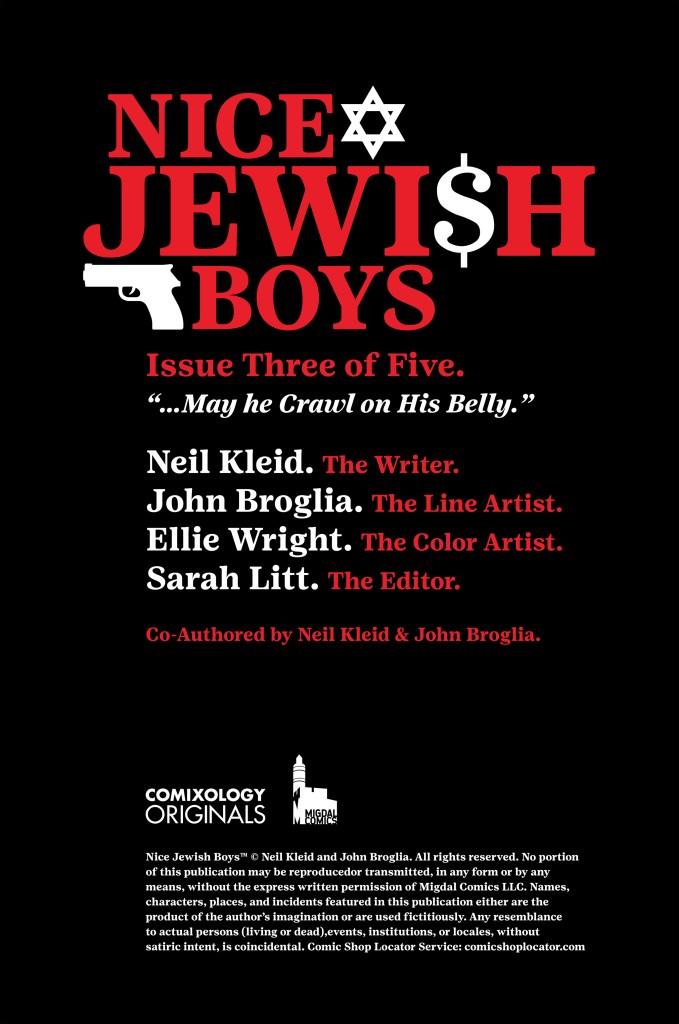
At the heart of the series is Jake Levin, a Modern Orthodox Jew facing financial struggles, who becomes entangled in a web of secrets when he starts moonlighting for his best friend. Unbeknownst to Jake, his friend is a kosher caterer-turned-criminal wanted by the FBI, with their failed entrepreneur-turned-informant pal further complicating matters.
Originally debuting in November 2023, as part of Amazon’s Comixology Originals, Nice Jewish Boys #3 is available today and promises a captivating experience within the backdrop of a gripping crime drama.
Check out the full interview below:
GN: Thank you for taking the time to answer our questions. Starting things off, can you tell us more about Nice Jewish Boys?
NK: Nice Jewish Boys is a contemporary, intimate suburban crime comic book set in Teaneck, New Jersey—a community in which I live, and which really represents any modern-day local community in which middle-class minorities either thrive or struggle to survive, attempting to make ends meet.
It was inspired by a true-life crime story about two Cleveland brothers who purchased a long-established butchery and then used it as a front for drug trafficking and money laundering, taking advantage of the local patrons and dragging the former owner’s name through the mud.
I have friends with local businesses here in town, and it got me thinking…if I had learned a friend of mine was involved in white-collar or blue-collar crime, would I be loyal to him or to the law and give him up? And if I accidentally got involved to my benefit…would I be able to stay silent?
Mostly, the comic is about my fears and anxieties and what it might be like to succumb to frustration with a system I love that can also be restrictive and expensive…and, in many cases, unjust and unfair to those who love what it offers in terms of faith, community and an elusive connection to something far greater than ourselves if only it would put aside the entitlement, judgment, and unwillingness to change.
It’s about brotherhood, it’s about bar mitzvahs, and it’s about betrayal.
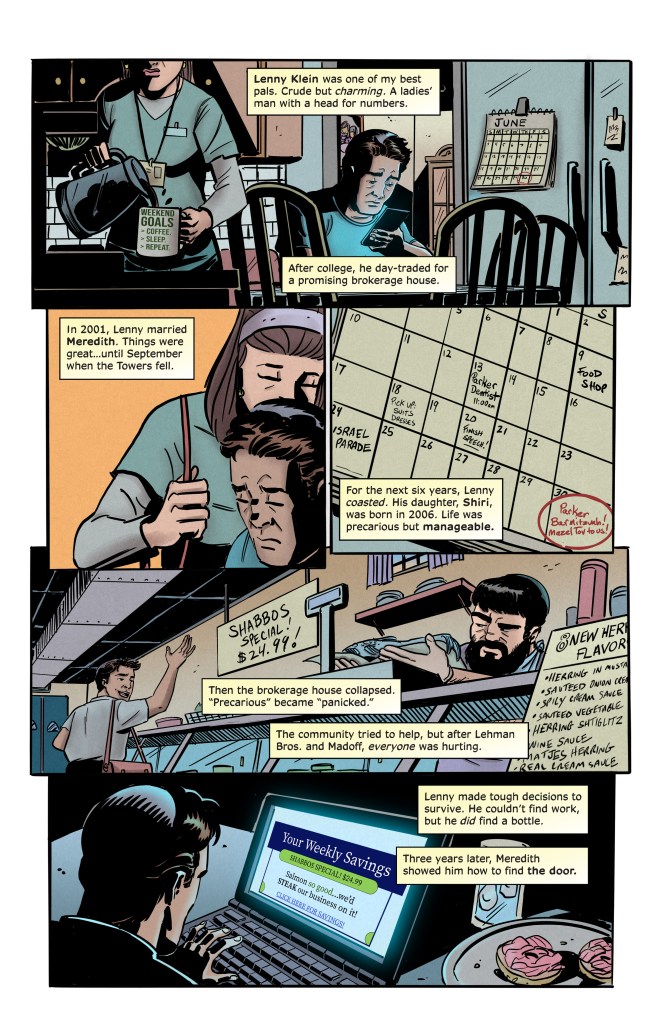
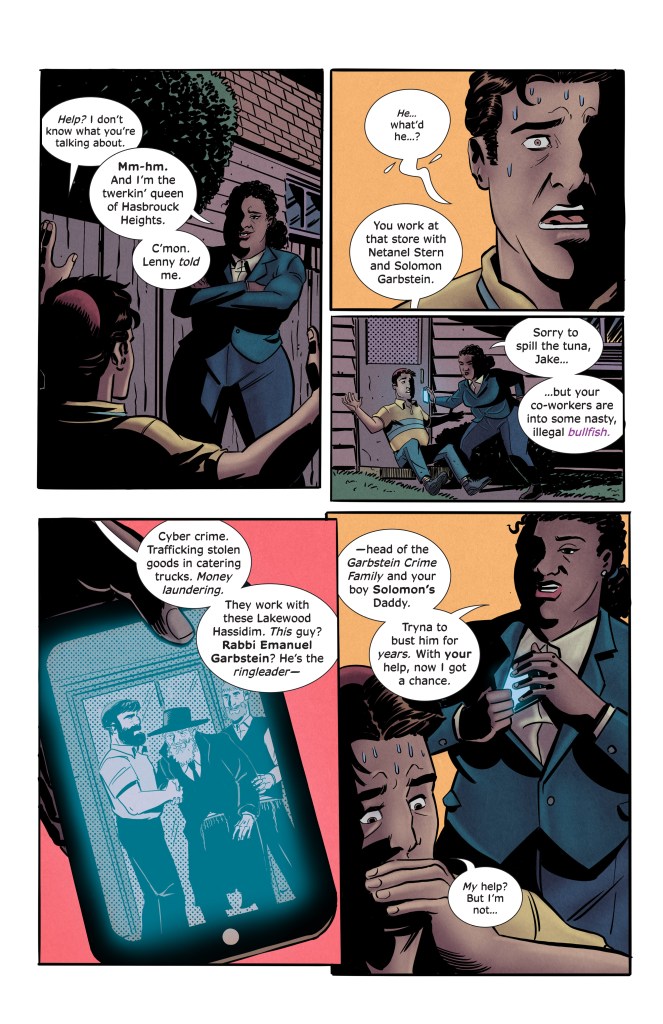
The story itself focuses on Jake Levin, a Modern Orthodox Jew struggling to pay his bills, who’s drawn into a triangle of secrets when he moonlights for his best friend, a kosher caterer-turned-criminal, who unbeknownst to him, is wanted by the FBI thanks to their other pal, a screw-up turned informant.
Five issues from Comixology Originals, written by me, illustrated by John Broglia, colored by Ellie Wright and edited by Sarah Litt. I hope people enjoy it and learn from it.


GN: A true crime story inspires this mini-series, was there any real-life or pop culture inspirations that you pulled from for Nice Jewish Boys?
NK: Yeah, like I said it’s inspired by actual events, specifically what happened to Tibor’s, a butchery in Cleveland right before the pandemic. The Cleveland Jewish News ran a series of articles about the sordid events that transpired at Tibor’s after the store was sold to the Senders Brothers. You can check that out here.
In addition, I watched a lot of Sopranos episodes for this one, as well as Goodfellas and Once Upon a Time in America…mostly, shows and movies about gangsters, and specifically New Jersey or Jewish gangsters.
But while I thought I was going to be making the “Jewish Sopranos,” in the end I may have taken a bit more from another famous TV anti-hero in Walter White—a good man trying to get by, drawn into doing terrible things for his family. You can definitely see some of that influence in the narrative.
But also…it was inspired by my life. I live in the Orthodox Jewish community, and folks who know me will definitely say that Jake is based on me. I’ve financed bar mitzvahs, and I struggle with the daily sacrifices of an Orthodox religious Jewish lifestyle. All I’ll say is this: Nice Jewish Boys is a work of fiction. there will be moments where truth may peek through that fiction.
It’s my hope those are the bits—amid the crime, anguish, guilt, and betrayals—which speak loudest and longest. And in the end, I hope people can relate to Jake’s story as much as I do, and the sacrifice he needs to make to survive. It’s a really common tale, unfortunately. My hope is that it resonates with all kinds of readers, whether they’re Jewish or not.
GN: Being from New Jersey, do you find it exciting to spotlight an area you are familiar with?
NK: Nervous, actually, more than exciting! It takes guts to make bold statements about the place where you live, breathe and eat, right?
I mean…sure, it’s fun to see John’s depictions of common landmarks from my neighborhood…but my bigger worry is that folks in Teaneck—specifically, folks within the Jewish community—will think I’m coming down on my neighbors and those around me, when really Jake’s story could happen in any town, to any Jews (or other middle-class, insular communities) anywhere around the globe. I just decided to set it close to home because, heck, write what you know.
That said, being familiar with the tri-state area did give me convenient locations for menacing moments throughout the book—from Paterson Great Falls to the nearby Catskill Mountains.
Look, I’m originally a Detroit boy and would love to write a comic set in the Motor City…but there was something really satisfying about placing this narrative in the streets around me. Hopefully, if all goes well, I can get to do a sequel and show more of the local area.

GN: This series is also based on your community’s fear and unwillingness to change, was it tough having to in a way, revisit your past and write about it?
NK: Well, I think those are separate things, really. It’s really about MY fear that the community is often unwilling to change…especially when we’re talking about specific systems—like private Hebrew school tuition, markup prices for kosher food, kickbacks to rabbinic authorities, and the unspoken hushing up domestic violence, substance, and sexual abuse, as well as the casual racism and homophobia too common in the very religious parts of the community.
Those are things I was afraid to write about because I worry folks will get angry at me — or people close to me— for being honest and pointing out ugly flaws that exist within a community that I love.
Look, I have kids. They may read this, and part of me is worried that they’re going to think I don’t love being Jewish or am angry at our community. Nothing could be farther from the truth. Teaneck—heck, most Jewish communities—are welcoming and wonderful and support those struggling within them.
There are tons of outreach and financial programs designed to give folks a step up and help those who need help. But…that doesn’t mean there aren’t problems, too. And a lot of the times—especially when talking about criminals close to those we know and love—we ignore those problems or don’t speak about them, pretending that all Jews are paragons of virtue, kindness, and righteousness.
Uh…Bernie Madoff was a Jew, fam. So were the Senders Brothers. So was Boruch Lanner and a lot of other monsters existing and thriving at the expenses of others in our Tribe. All I’m saying is, yes, shine a light on the wonderful aspects of who we are…but let’s also point out the problems, so we can raise them as concerns and maybe fix what’s broken.
So yeah; tough. Nervous? For certain. I definitely believe many folks—Jews and non-Jews—will hate this comic and its narrative. But hopefully, many more will understand what we’re trying to say and maybe, hopefully, some sort of change will come. Only time will tell.
GN: What message do you hope your readers get from reading this story?
NK: It’s okay to love something—truly love it with all your heart—and still be able to condemn it for its institutional flaws. But more importantly, in the end no matter where you’re from or who you are—Jewish or not, from any racial or religious background—all people are struggling to survive in some way…
and if you have something or someone who can help you get through it—something in which to believe, whether friends or family, G-d or art or sports or whatever—then devote yourself to that thing and hold onto it for dear life, doing whatever you can to do right by it…and hopefully, that thing will do right by you in return.

Leave a Reply