
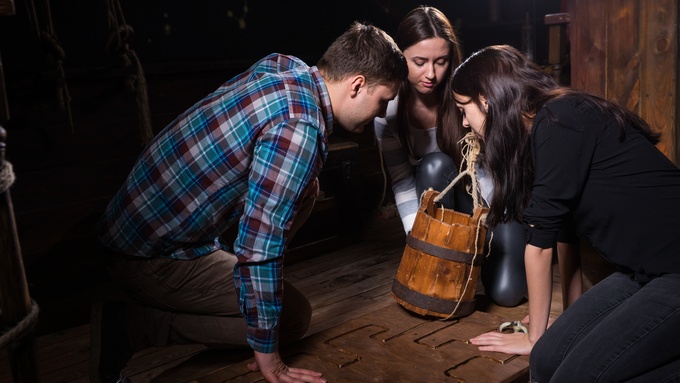
Anyone who has joined a raid, assembled a tabletop party, or spent an evening coordinating a co-op campaign knows that teamwork can be as important as individual skill. One player spots the hidden path, another understands the puzzle mechanic, and someone else keeps the party focused while everything goes spectacularly wrong.
Escape rooms take that familiar dynamic out of the digital or imagined world and put it into a physical space. How escape rooms bring RPG-style teamwork into real life becomes especially clear when a group is faced with a shared objective, limited information, environmental clues, and the need to combine different strengths. Nobody needs a character sheet or controller—the party is already in the room.
Every Group Develops Its Own Party Roles
RPG parties work because members rarely contribute in exactly the same way. A traditional fantasy group might have a fighter absorbing damage, a rogue checking for traps, and a wizard solving problems with knowledge or magic. Multiplayer video games create similar divisions through classes and specialized abilities.
An escape room does not formally assign those roles, but groups often create them naturally. One person may become the investigator who notices tiny visual inconsistencies. Another might be excellent at decoding patterns or working through number puzzles. Someone else may remember a strange symbol seen 20 minutes earlier. There is often also a de facto party leader who keeps track of unfinished puzzles and prevents everyone from spending too much time staring at the same suspicious bookshelf.
These roles can change throughout the experience. The person who cracks one elaborate cipher might have no idea what to do with the next spatial puzzle. That flexibility makes the group dynamic feel closer to a cooperative RPG than a straightforward test with one correct problem-solving method.
Communication Becomes a Core Mechanic
In many games, communication is something players use to deal with mechanics. In escape rooms, communication effectively becomes one of the mechanics. A clue discovered in one corner might make sense only when paired with an object someone else found across the room. If those two players never communicate, the solution can remain invisible even when every necessary piece is sitting in plain sight. That creates the real-world equivalent of the classic multiplayer moment when one party member has information everyone else desperately needs.
Effective teams tend to announce discoveries, share theories, and explain what they have already attempted. Just as importantly, they listen. A seemingly ridiculous observation can turn out to be exactly what breaks a puzzle open. This is where escape rooms differ from many solitary puzzle experiences. Solving something personally can be satisfying, but realizing that three separate discoveries fit together creates a distinctly cooperative payoff.
The Environment Acts Like a Game World
RPGs rarely present challenges in a vacuum. A dungeon, abandoned laboratory, haunted mansion, or mysterious spacecraft gives context to what players are doing. The setting helps turn a sequence of objectives into an adventure.
Escape rooms can use physical environments in much the same way. Lighting, sound, props, set design, hidden compartments, and interactive elements make exploration part of the experience rather than simply decoration.
The effect is strongest when puzzles seem to belong to the fictional world. A cryptic journal makes sense in a mystery. Strange controls fit naturally aboard a sci-fi vessel. An old lockbox feels at home in an adventure setting. Thoughtful immersive escape room design can use elements such as atmosphere, sensory details, and environmental storytelling to make players feel involved in a scenario rather than merely surrounded by themed puzzles.
Different Types of Intelligence Get a Chance To Shine
One reason RPG parties are compelling is that usefulness is distributed. Strength matters in one encounter, while diplomacy, perception, knowledge, or creativity might matter more in the next. Escape rooms can create a similar effect without attaching numerical stats to anyone.
Pattern recognition may solve one challenge, while visual observation unlocks another. Spatial reasoning, memory, logic, wordplay, organization, and even the ability to remain calm under a countdown can all become useful skills.
That variety can produce surprising MVP moments. The friend who insists they are bad at puzzles may immediately understand an unusual physical mechanism. A player who has barely contributed to several logic problems might remember exactly where a matching symbol appeared earlier. There is no glowing “+10 Perception” notification, but the feeling is recognizable.
The Clock Creates a Real-World Quest
RPGs frequently build urgency through narrative stakes: stop the ritual, escape the dungeon, rescue someone, or defeat the boss before disaster strikes. Escape rooms have a direct version of that pressure—a clock that is actually counting down in the room.
Time changes how teams behave. With unlimited time, players could inspect every possibility at leisure. A countdown forces decisions about when to abandon an idea, when to ask teammates for help, and how to divide attention. Suddenly, organizing the party matters almost as much as solving the individual puzzles.
That pressure can also make successful moments more memorable. Discovering a hidden compartment is satisfying, but discovering it with only minutes remaining while the entire group realizes it contains the final piece feels much closer to the climax of a game session.
The Best Moments Belong to the Whole Party
Game developers have long understood that shared victories can create stories players keep retelling. The appeal is not simply completing an objective; it is remembering how the group completed it. That is ultimately how escape rooms bring RPG-style teamwork into real life. They transform familiar cooperative concepts like specialized roles, communication, exploration, puzzle-solving, time pressure, and shared victories into actions that happen in a physical environment.
There is no need to imagine the rogue searching the wall for a hidden switch because someone is actually searching the wall. The puzzle expert is surrounded by real objects instead of inventory icons. The party leader is trying to coordinate several excited people at once. And when everything finally clicks, the celebration is not happening through headsets; the whole party is already standing together in the same room.
Leave a Reply