
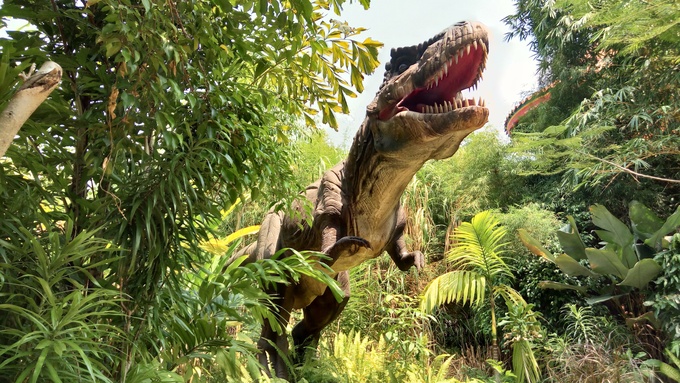
If you think of raptors, you probably see the Jurassic Park version first. Tall, fast, scaly, and always one step ahead of the humans chasing them. That image stuck because the films made it feel definitive.
The problem arises when film design replaces fossil-based anatomy. The real animals still feel dangerous and fascinating, just in different ways. Once you look closer at the facts, it’s easy to spot whatJurassic Park got wrong about dinosaurs.
Some Had Feathers
The Jurassic Park franchise depicts all dinosaurs as scaly, partly because this is a widely held misconception. However, feathers are one of the defining characteristics of velociraptors, as evidenced by quill knobs found in fossils. These dinosaurs likely had feathers on their forelimbs to enhance aerodynamic performance during the pursuit of prey.
Moreover, feathers would have altered a raptor’s silhouette, making it appear less like a sleek reptilian hunter and more like a birdlike predator on the ground. The tail and arms may have borne feathers that aided balance and rapid turns, thereby altering how the animal moved and struck.
Velociraptors Were Much Smaller
In the movies, the velociraptors are large enough for characters to ride like horses. Although this contributes to the sci-fi action-movie aesthetic, it’s far from accurate. In fact, real velociraptors were closer to the size of a turkey, measuring at around 1.5 feet tall at the hip.
The velociraptor’s smaller frame alters its behavior. Speed, balance, and quick directional shifts matter more than raw presence. The filmmakers likely chose size because it reads as threatening on screen, even though the real animal relied on mobility.
Hands Moved Differently
Another thing Jurassic Park got wrong about dinosaurs is the way the beasts’ hands moved. In the movies, bipedal dinosaurs often hold their hands with their palms facing down. The problem is that their wrist bones would not have allowed that position. The correct orientation places the hands facing inward, like a bird folding its wings.
The inward orientation of the hands enables grasping and more controlled movements rather than wide slashing motions; it matches the way the arms connect to the shoulders. As a result, the movie posture emphasizes visual menace rather than reflecting actual anatomy.
Pack Behavior Went Too Far
In Jurassic Park, the dinosaurs appear highly coordinated, planning attacks together. That level of teamwork exceeds what the physical evidence indicates. Most interactions likely involved short bursts of action and occasional group presence rather than organized planning.
Some fossil trackways show multiple dinosaurs moving in the same direction at the same time, suggesting they could tolerate one another in proximity. Sharing territory or hunting alongside other dinosaurs does not equal long-term cooperation.
Species Weren’t Enemies
Movies often show dinosaurs attacking each other on sight, but reality was different. Many species shared habitats without constant fighting. Conflicts likely occurred over food, nesting areas, or mates, but they were not continuous battles.
Fossil evidence shows multiple species living in the same area peacefully, such as hadrosaurs and ceratopsians found together in bone beds. Trackways indicate coexistence rather than constant predation. Coexisting with one another, they shaped a world that was active, surprising, and always in motion.
Leave a Reply