
From the bold slogans of protest movements to the quirky memes you wore to your last family barbecue, printed T-shirts are more than just fabric with ink. They’re incredible snapshots of culture, personality, and, occasionally, questionable fashion choices.
But have you ever wondered how this beloved medium of self-expression came to be? In this article, we’ll take a closer look at the short but fascinating history of T-shirt printing and how it has evolved into the colorful industry it is today.
The Origins of T-Shirt Printing
We can trace the humble T-shirt as we know it back to its roots in the early 1900s. The T-shirt was originally an undergarment for U.S. Navy sailors—plain, practical, and far from the fashion statement it is today.
However, its potential as a canvas for self-expression began to emerge in the mid-20th century, sparked by advancements in printing techniques and cultural shifts. Some of the earliest printed T-shirts appeared as promotional tools—think of the now-iconic tees advertising The Wizard of Oz in 1939. Those T-shirt ads marked the beginning of what would become a multi-billion-dollar industry.
Key Historical Milestones
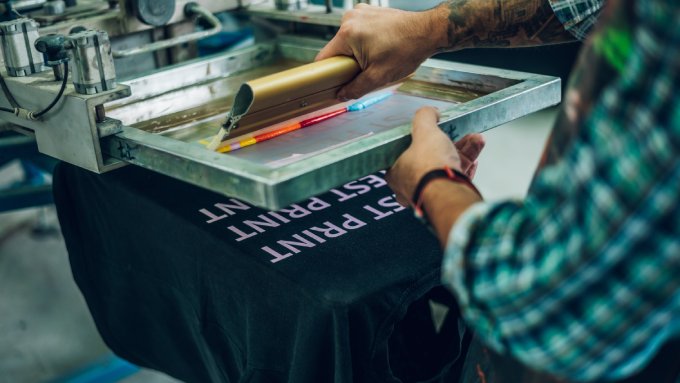
Fast forward to the 1960s, and the T-shirt had become a cultural icon. Screen printing, a method dating back centuries but refined for fabric in the mid-20th century, allowed designers and activists alike to create bold, eye-catching messages.
Early adopters included The Beatles and revolutionary figures such as Che Guevara, whose likeness made its way onto countless tees. By the 1970s, tie-dye kits exploded in popularity thanks to the counterculture movement. Psychedelic patterns and vibrant colors dominated clothing racks, proving that T-shirts could be both art and an expression of one’s identity.
The 1980s ushered in commercial graphic tees. Major brands, such as Coca-Cola, MTV, and Nike, leveraged T-shirts as walking billboards, blending fashion with advertising. Who could forget the “I Heart NY” shirt, originally designed to promote tourism but quickly evolving into a worldwide symbol?
The Evolution of Printing Techniques
The printing process itself has undergone significant changes over the decades. Traditional screen printing provided durability and bold designs, but it was labor-intensive and limited in detail. The introduction of heat transfers in the 1970s made it easier to mass-produce intricate graphics, though the quality wasn’t always long-lasting.
By the 1990s, direct-to-garment (DTG) printing transformed the industry. This technique functions much like a desktop printer, applying ink directly to fabric for stunning detail and unlimited color options. In the early 2000s, direct-to-film (DTF) printing took over, making T-shirt printing more accessible for smaller businesses or creatives wanting to experiment with sublimates.
Cultural and Social Impact
T-shirt printing has always been more than just a method of decoration—it’s a vehicle for cultural and social dialogue. Over the years, printed T-shirts have given individuals a voice, whether through protest slogans such as “Make Love, Not War” during the Vietnam War era or movements such as Black Lives Matter.
Beyond activism, T-shirts capture nostalgia and humor, immortalizing everything from vintage band logos to internet memes. They’re a powerful equalizer worn by people of every background and social status.
And there you have it—the colorful, quirky, and surprisingly short but fascinating history of T-shirt printing! From its humble beginnings as an undergarment to becoming a blank canvas for art, protest, and outrageous puns, the printed T-shirt has truly earned its place as a cultural icon.
Leave a Reply