
It’s no secret that behind most superheroes lies an origin story filled with trauma and grief, and more often than not, you can draw parallels between the hero’s powers and how the hero deals with their trauma and grief. The Flash is a speedster who often tries to outrun his problems or solve them as quickly as possible, only to learn that there is no fast way to solve them. Bruce Banner suppresses his emotions, channeling them inward until a trigger turns him into the Hulk, a towering green Goliath bursting with rage. Tony Stark has no powers, but he does something we can all relate to. He cocoons himself in an iron suit so he can’t get hurt.
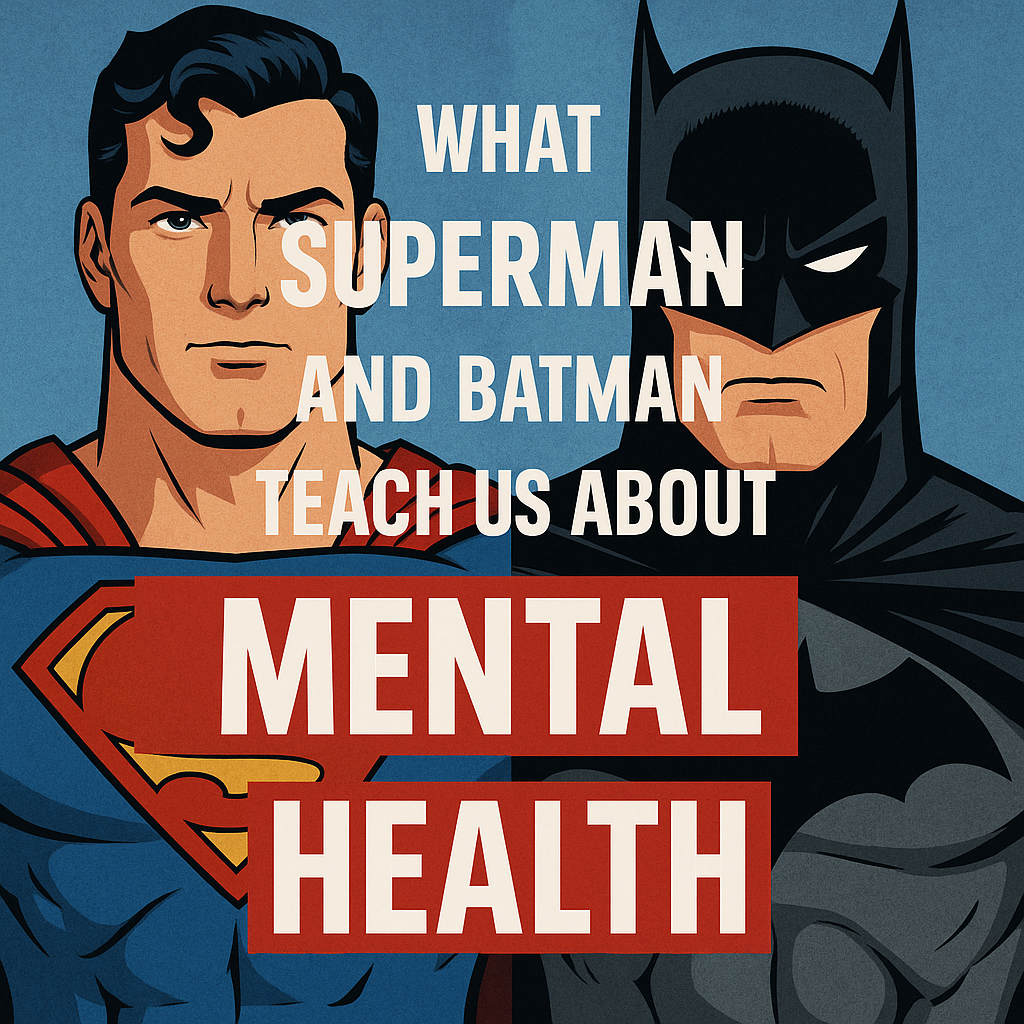
Two of my favorite heroes from DC Comics make for an interesting metaphor when you start exploring the relationship between mental health and superpowers. Superman and Batman are two of the most famous comic book superheroes, not only from DC Comics, but also with very different backgrounds, powers, and character traits. For years, writers have paired Superman and Batman in adventures, despite their inherent differences. Their approach to heroism is so different that they often find themselves at odds with each other, even though they share the same goal. That is an interesting metaphor. How often do we find ourselves at odds with a loved one who is suffering from poor mental health? Whilst trying to help them through difficult times, we end up falling out because our perspectives are wildly different, but the goal of wanting to be better is shared between you both.
Superman AKA Clark Kent AKA Cal El is the last survivor of a planet called Krypton, hence his title (the last son of Krypton), which is a title I’ve never held much stock in because over the years, as it has been revealed, he isn’t the last survivor of Krypton at all. His cousin, Cara (Super Girl), is still alive, as is Zod, and a few others who appear in various story arcs over the years. However, for the purposes of this article, we will ignore the plot holes of a story that has been told and retold over 70 years. Superman’s parents sent him to Earth in a spaceship before his planet’s inevitable destruction, leaving Superman as one of the “last” Kryptonians alive. Despite the trauma of being an alien orphan, raised by American farmers from a small town called Smallville, and adopted by Earth as its protector, he is both feared and revered because of his god-like powers. Superman chooses to be a symbol of hope, despite all that he has been through. Whether he’s saving a bus full of orphaned, blind nuns with their seeing dogs. Or the world from the clutches of Lex Luthor, Superman’s nemesis, Superman is always on hand to help in the most wholesome way possible.
Batman, aka Bruce Wayne, is a troubled billionaire who witnessed the brutal murder of his parents, Martha and Thomas Wayne, as a young boy. After a trip to the opera, the Waynes were shot in a robbery gone wrong in front of a young Bruce Wayne, leaving him an orphaned billionaire to be raised by his butler, Alfred Pennyworth. You could argue that, as the heir to a fortune, he had all the tools at his disposal to process his trauma and become a well-rounded, functioning member of society. However, the first thing that Batman’s heroic journey teaches us is that money does not buy you happiness. Overwhelmed by his trauma and consumed by grief, Bruce Wayne assumes the alter ego, Batman. Bruce Wayne becomes a totem of fear to terrorise Gotham City’s criminals. He exploits the very fear that the criminals instil in them. Using his trauma and grief to fuel his motives and give him strength, this makes him more of an antihero than a hero as Batman is willing to cross lines that other heroes dare not.
Both Batman and Superman are considered formidable heroes in their shared universe, but in dramatically different ways, presenting an interesting lesson for those trying to better understand trauma and its effects on a person’s character and life choices, depending on how they choose to process that trauma.
When processing trauma and grief, your main fork in the road to recovery is the choice between victim and survivor. I bet you just read that again and thought to yourself, “Hang on a minute, neither Batman nor Superman are victims. They’re both heroes”.
Well done, you’ve just highlighted one of the biggest stigmas with regards to mental health. You can still be “a victim” and get shit done.
Allow me to explain what I mean. Superman is quite literally a survivor. He survived the destruction of his own planet and often wears this fact like a badge of honour. This survivor (complex) of his is further fuelled by the fact that he is pretty much invulnerable whilst on planet Earth. Superman’s near invulnerability leads him to often throw himself in the path of danger to protect others with little to no thought, he is the epitome of a selfless protector. It has been posited in multiple Superman stories that his reason for such selfless heroism is that he carries tremendous guilt for surviving when his entire race is dead. Every life he saves is to counter that heavy guilt. Superman’s immense power is due to our young, yellow sun. Kryptonians can drink the radiation from our sun and turn it into unrivalled superpowers. What do we do when we feel low and need a pick-me-up? We go for a walk outside or take a holiday somewhere sunny. The sun strengthens our mental resolve because the sun’s radiation helps us produce vitamin D, otherwise known as the happy vitamin. So, we are all a bit like Superman? Or is Superman more like us than we realize?
Speaking of what Superman wears. Most people are familiar with his iconic blue and red suit, but did you know that the symbol on Superman’s chest is the Kryptonian symbol for hope? Every problem Superman faces, both past and present, Superman tackles it with an abundance of hope. Superman’s greatest conflicts and defeats often happen when his unshakable hope is brought into dispute.
Bruce Wayne is literally a survivor himself, but the way he has handled his survivor’s guilt is entirely different to Superman. Bruce Wayne may have survived the robbery that killed his parents, but he is also a victim of his mother and father’s deaths. He is plagued by the death of his parents and in many ways, still that little boy. Bruce Wayne has held on tightly to his grief and trauma and used it as a source of strength. As the Batman, his strength comes from the shadows of his past. Batman has used the very darkness within him to battle the crime-ridden streets of Gotham. The bat that so often haunts Bruce Wayne’s nightmares is the manifestation of his trauma and grief. The bat that he fears becomes the very symbol he brandishes on his chest for all to see.
Batman’s behavior is typical of someone with PTSD (post-traumatic stress disorder) this is when unprocessed trauma stays with the victim and presents the victim with nightmares, flashbacks, depression and anxiety (among other symptoms). Batman sees the face of his parent’s killer in every foe he goes up against, which often leads him to questioning his own moral code (he will not kill or use guns). This strong moral code is the only thing that keeps Batman on the path of righteousness, an imperative as Batman walks such a fine line between hero and villain.
Batman and Superman really hold a mirror up to how so many of us subconsciously choose to deal with our mental health. Some are able to let go of our grief and choose a path of hope and we chase healthy coping mechanisms over unhealthy coping mechanisms. We process our trauma in order shine a light on the darkest corners of our mind, we exercise the demons that wish to keep us fearful in the shadows and then use those skills to help others around us.
There are those of us that are consumed by pain, unable to let go of the horrors of the past. These people are almost two different characters. The version of themselves that they present to the world are playful, confident and happy. But in the lone darkness of night, they become their true selves. Plagued by their trauma, they do whatever it takes to survive no matter how dark. They walk that fine cultural line of good and bad clinging onto a self-proclaimed moral code that justifies their actions.
What Batman and Superman really highlight is that it’s not about the right or wrong way to handle your trauma and it’s not even about what’s good or bad. What is good or bad? They are objective constructs that change depending on who you are and your point of view. Every villain is the hero in his own eyes. There are healthy ways and unhealthy ways to deal with your trauma and neither option makes you a good or bad person. If you were to handle your trauma like Superman, you may be a beacon of hope that others look to for inspiration. Walking boldly in the light of the sun, a picture of mental and physical health. But you may be forever wary of our Kryptonite or become careless due to your sense of imperviousness, leading to your inevitable down fall. Those who appear to be the strongest on the outside so often hide a vulnerable core. If you were to walk in the shadows with Batman, you may be plagued by your past with nightmares and flashbacks, at one with your pain and you would be forgiven to believe you were weak minded for being unable to move past the trauma, but your mental strength would be stronger than most. Your coping strategies may not be considered the healthiest or most sustainable, but you survive, and by doing so, you demonstrate unmatched resilience under the darkest of conditions.
I think we all know Superman or Batman. I also believe that we can be both Superman and Batman, sometimes leaning more towards one than the other. Both characters are two sides of the same coin, exaggerating the human condition. If we could strive toward that balance of fearlessness and hope, then we too would possess incredible mental resolve and find enough hope within ourselves to help others achieve the same outcome. Who are you more like? Are you a Superman, too busy helping others to accept your own trauma? Or are you a Batman, staring your pain so firmly in the eyes that you are unable to accept the possibility of hope? Is there room within you for the duality of fearlessness and hope? Mental health is a broad and complex issue that is often easily intimidated and shied away from in polite conversation. If you are struggling to explain yourself or trying to reach someone else who is struggling. Something as simple as a comic book could make all the difference. Unlike comics, our story hasn’t finished, and our internal struggles have not yet reached a resolution, but our favorite superheroes have lived through many stories and have many lessons to teach us. Just because they are fictional, it does not make them any less valid. For every life is a story waiting to be told.
Until next time…
DB

Leave a Reply