

Joe Nicklo Seeks To Put Comic Shops in the Spotlight with His New Documentary Surviving Comics
Can the Comic Book Industry Survive Another 100 Years?
Director/Producer: Joe Nicklo
Co-Director: Danny Soto
Cinematographer: Locksley Lennox
“One of our major goals with this documentary is we want to show the world that comic books and comic book shops are a major part of American culture and they are in danger of disappearing.” ~ Locksley Lennox
Good ole comics, one of the oldest art forms, are, next to newspapers, the longest-running printed industry in the world. But for how long can it last? Is there an end to the yellow brick road for comics? With all the cinematic adaptations, convention attractions, and merchandising, you’d think the business would have Scrouge McDuck swimming in a sea of overwhelming gold coins, but what if our assumption is the biggest—illusion?
Joe Nicklo, a lifetime comics fan, is bringing his specialty inside the heart of America’s most historic comic shops to answer the question that constantly plays peek-a-boo with comic fans, critics, and professionals worldwide: Can the comic book industry survive another 100 years?
The professionals will probably tell you it’s a long shot, but when you’re too close to the product, can you stay objective about the prediction? Especially with the rise of sales funnels, capital investment schemes, and online e-commerce shops, some of which have been completely automated by the rise of technocratic developers. Let’s say bigger comics corporations survive, but shops don’t.
Indie comics might be around, but conventions that suffer the loss of comic shop vendors could contribute to a drop in attendance, and without shops, distribution in print crumbles. Just last week, printing costs around the United States jumped by almost $1.50. For most comic publishers, that won’t hurt, but not for Indie.
If distribution crumbles because they have no shops to sell to, then it would force bigger publishers to either move their stock to traditional brick-and-mortar retail or open up exclusive publisher stores costing hundreds of thousands if not millions business expansion and restructuring. To a boardroom full of greenback collectors, would it be worth it to them?
Hypothetical posturing aside, it doesn’t help small business owners now, nor does it make it possible for indie comics to thrive, because then smaller publishers would have to change their entire business dynamic to an online format or another hybrid model to make a profit. For some people, data entry isn’t worth the work, and for others, the cost of paying other third-party services to build websites would cost too much out of pocket, sending thousands of creators to the banks, gambling their financial freedom for a stake in doing what they love.
Or maybe these desperate business owners would have to step in front of the camera to stream their gems in apps like Whatnot or TikTok. Let’s not even get started on how those types of outlets are sufficient. Joe, a filmmaker, is bringing the voices of the brave shop owners around the country hopefully to the big screen and streaming services, to ring the bells to big publishers and corporations that care more about option deals and getting investors more dollars than what it means to connect with a community.
If the recent drop in dollar signs hasn’t rung alarms through the offices of DC or Marvel, then the Titanic might already be sinking, and this documentary will mark the last call for life rafts before DiCaprio sinks to the bottom of a cold, dark void. But let’s not be too morbid just yet.
Now, don’t go running to the remnants of Twitter and tweet that the comics apocalypse is coming, because what I think this documentary is going to do is give us a really good look at shop owners asking big companies and publishers to help find a way to balance the culture.
Just today I ran across a story where Mark Millar and Jimmy Palmeotti, including a few others, were tagged in a video that ran across Comics ‘X’ complaining that a lot of comics creators at large publishers are not focused on telling good stories because the culture has been somewhat hijacked by individuals who write stories about how they would be Iron Man or Superman.
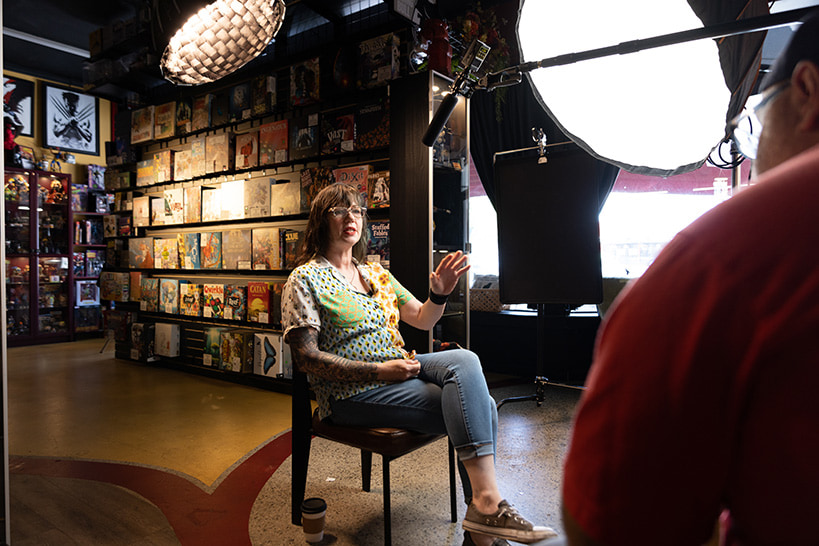
This is obviously a passionate topic among the community, which Joe feels compelled enough to help preserve because comic shops are a place where you can go and know no one and experience that instant synergy with another fan just by interest alone.
That Twitter post by the owner, O’Leary, posted by @DefNotTy has racked up 2.7 million views since December 3. I have to say that from where I stand, I see where most shop owners and fans are coming from. It’s just as much of a grind to own a shop as it is to make comics, but corporations write off the debt in red every day, knowing they’ll make their scratch back on merchandising and options opportunities.
To those without the means, it seems unfair, but I also see the corporate side of things because once you run green, there is no stopping. Indie comic creators know this best. We sink $5,000 into a book, then spend all year earning that back just to reinvest in another book, then hop to a new intellectual property and start all over. I think what most fans don’t see are the licensing fees, legal costs, trademark expenses, storage fees, data or server costs, taxes involved, and insurance expenses.
I’m not making excuses, but if it were easy, everyone would be the CEO of Marvel. That doesn’t mean investors have learned the tax loopholes to make it worthwhile, but comics come with a cost, and the question everyone wants answered is whether the cost going to continue to be worth it in the future.

I will say that I agree with their needing to be a balance, where without the small fish pushing that item, the big fish are just wasting their time. So how do we make it better? Is the writing and culture within the pages of comics we’ve grown up with changed so much that it’s driving away readers? Are people choosing convenience shopping online over going to local shops? I do think comics will be around in 100 years.
I think the silver lining is that evolution doesn’t always mean extinction. A story put out by comicsbeat.com last year predicted that comics always find a way to thrive in times of economic hardship confident in their sourcing from a Forbes analyst. I don’t think the format or the process will be done the same way, but if we follow history, then we can be assured that if life finds a way, so too will comics.
As the path of digital tools opened the gates for new creators, automation and artificial intelligence are opening a whole new gate to an entirely different kind of creator. And if the leaders and corporations of the world decide the digital age is the future, then comics will be experienced in ways we can only imagine. For some of us, the experience of a shop visit will never be the same.
Support Joe and his team by signing up for the Indiegogo campaign that’s currently in prelaunch so you get notified when it launches. The more money these filmmakers raise, the more shops around the country will get a chance to put their two cents in, and the better chance we all have of being a part of our comics cultural shift.
A shift that will keep comics running for a hundred more years. Don’t forget to support your local comic store or visit your favorite artists and creators at cons. As always, stay geeky, share the network, and don’t forget to catch me on the latest episode of Comics’N’Poptarts.

Michael J. Florio
Michael is a versatile creative professional, excelling as a comic writer, editor, and screenwriter. He holds notable credits at Advent Comics, Grok Comics, Champion Comics, Alter Ego Arts, and Super Serious Comics, Mazzi Productions not including his own projects like Wild Oni and Iron Jaguar.
Aside from being an internationally published editor, Michael has been the editor-in-chief at Inked Studios, where he’s assisted on over 40 crowdfunding campaigns, contributing to projects like Exiled (Wesley Snipes), Redempt1on (Austin St. John), and Bleeding Pulp (Justin Gray). Holding degrees from the University of Full Sail, Michael resides in Biloxi, Mississippi, where he hosts the Comics’N’Poptarts podcast and actively engages with the Mississippi Gulf Coast Writers Guild Chapter, sharing comic expertise.
Beyond his creative pursuits, he enjoys family time, storytelling, film analysis, comic reading, and honing voice acting for future prospects.
Leave a Reply