
Issue x Issue | New 52 Batman Part II
Welcome Back to Issue x Issue
Welcome back! If you haven’t read last week’s Issue x Issue where I dive into the first seven issues of New 52 Batman, you should do that by clicking here before diving into this week’s analysis. Issue x Issue aims to dive into specific creator runs, arcs, or events in comic history and break them down issue by issue. This week we’ll continue the journey through Scott Snyder and Greg Capullo’s run on Batman with issues #8-#11.
Bats vs Owls
The way comics are collected in various editions and trade paperbacks can be a bit weird. Though I covered seven issues in Part I of this analysis, I’m only tackling four here. This is because the second trade of this series includes issue #12 – not illustrated by Capullo and also not really a part of the larger Court of Owls arc – and the Annual issue released that year – also not part of the Owls arc. The main Court of Owls story reaches its conclusion in issues #8-#11, so that’s what I’ll be sticking to today.
These issues are fairly straightforward. The majority of the groundwork and buildup was handled early on, so these issues are the creative team nailing the payoffs they already set up. Written by Scott Snyder with art by Greg Capullo, inks by Jonathan Glapion, and colors by FCO, Batman #8-#11 delivers a ton of action, twists in the mystery with a satisfying conclusion.
It’s perfectly dramatic.
The back half of this arc opens with Bruce being tremendously moody and dramatic, overlooking his model of Gotham City in the dark while nursing the wounds from his time in the Court’s labyrinth. The conversation between Bruce and Alfred is suddenly cut short by intruders breaking into Wayne Manor. Talons – sent by the Court of Owls – have arrived. The rest of this issue transforms into a cutthroat brawl as Bruce fends off Talon after Talon on his way to the Batcave. Capullo, Glapion, and FCO craft a killer action sequence as Bruce fights from the roof of Wayne Manor to the cavernous depths below.
The main section of this issue ends with Bruce donning the Thrasher Batsuit – an exo-suit designed to withstand extreme conditions and climates – and emerging from the armory to battle with all the Talons gathered in the Batcave. Things transition as Rafael Albuquerque takes over on art for a sequence that establishes that the Talons throughout Gotham are targeting high-level city officials for assassination.


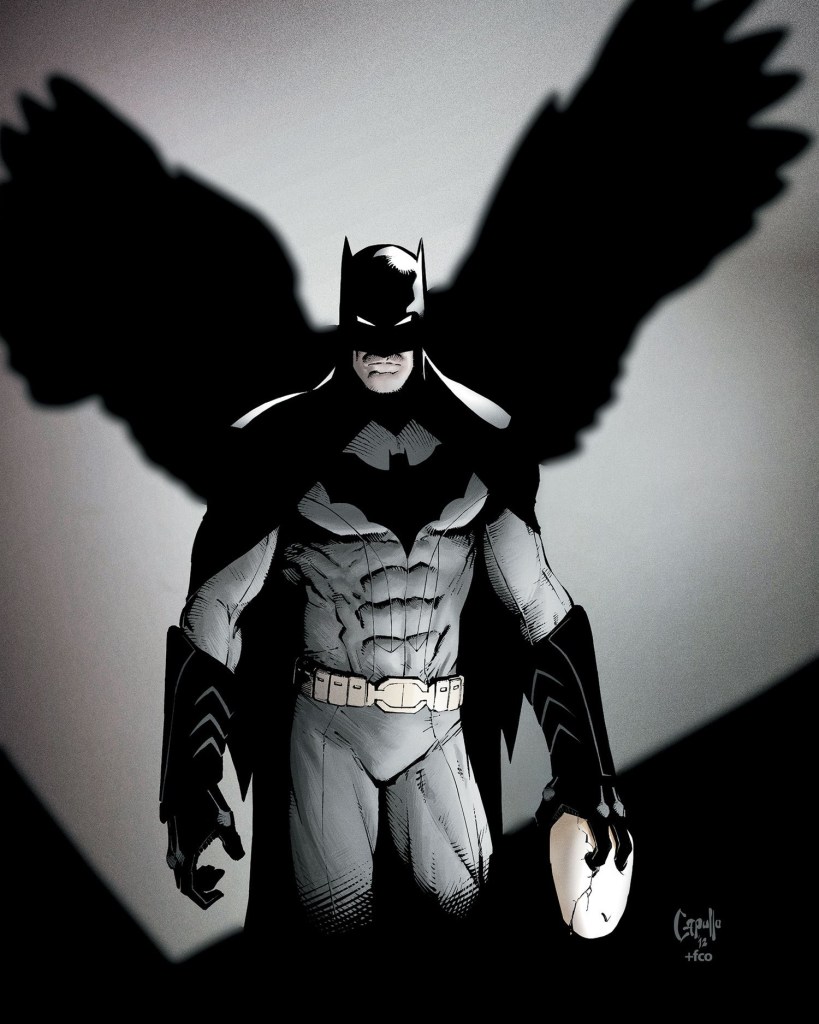
Issue #9 picks up with Batman fighting off a dozen Talons in the Thrasher Batsuit. Before detailing the impressive specifications of his new exo-suit, Batman begins the issue narrating the history of owls and bats in the caves beneath Wayne Manor. The narration comes to a crescendo as Batman emerges from the Thrasher Batsuit, noting that the bats returned to the cave with a vengeance. It’s perfectly dramatic and one of the best pages in the entire run. Batman of course fights through the Talons and rushes to thwart the remaining assassination attempts, ending with a trip to Lincoln March’s office.
Capullo, Glapion, and FCO consistently raise the bar for how good a Batman book can look.
Batman arrives too late, as March shoots a Talon hiding in the shadows after having already received a fatal stab wound. March dies giving Batman a clue about where to find the Court, and Batman ends the issue by vowing to burn the Owls’ home to the ground. The following issue sees Batman break into the Powers’ penthouse, strike fear, find the Owls’ secret meeting location, and discover them all dead – seemingly poisoned. Snyder makes a nice narrative turn here when he has the location of the Owls’ meeting be the very same building Bruce had investigated as a child.
It’s a great way to tie the mystery back around to earlier threads, and keeps the narrative wrap-up fresh. As a child, Bruce found nothing but dust and disappointment at the end of his search. Now, Bruce finds the Court exactly where he always knew they were, yet he’s still greeted with disappointment. The discovery doesn’t end in catharsis, it simply ends. The back half of the issue picks up with Bruce unraveling one final thread in the mystery…
Brother vs Brother
Bruce couldn’t help but feel like there was something in the case that he missed, and a particular pin that his mother is wearing in one of the pictures on the wall sends Bruce on a mission. Batman arrives at the derelict Willowwood Home for Children and is greeted by none other than Lincoln March. Lincoln March is revealed to be a false identity, a useful tool for the Court of Owls to further manipulate Gotham. March claims he’s Thomas Wayne Jr., the younger son of Bruce who was left abandoned at Willowwood after the death of the Waynes. He claims to be the brother from the other side of the mirror, the dark reflection of Bruce’s Batman.
It presents an intriguing, fun-to-follow mystery with a handful of twists and turns, and it’s an easy jumping-on point for new and old fans alike.
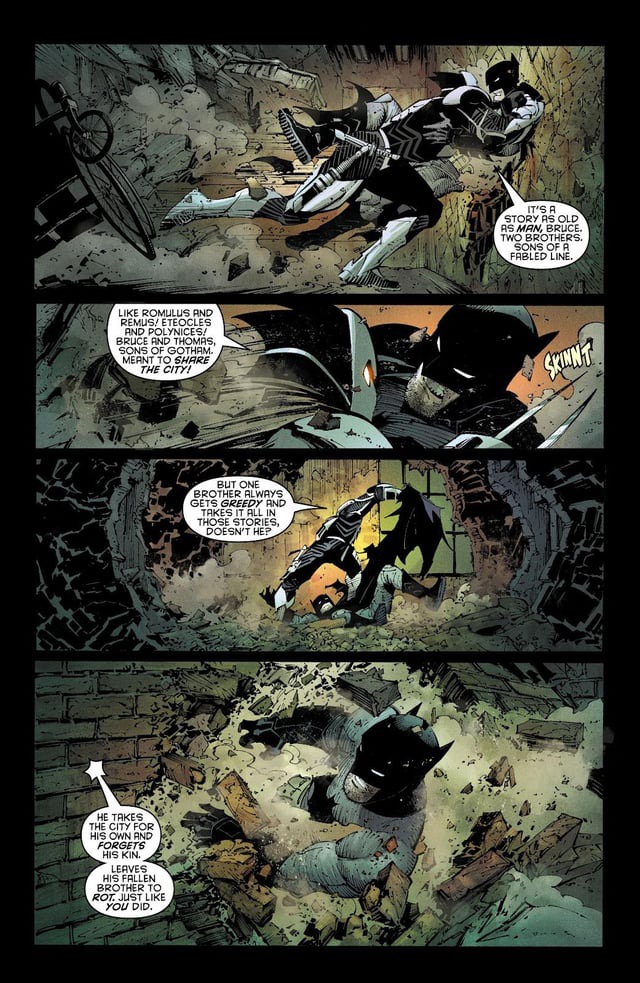
For me, this reveal works on multiple levels. On one level, it’s a reintroduction and new adaptation of the classic character Owlman. Though Thomas Wayne Jr. never goes so far as to call himself Owlman on panel in this arc, the dude is walking around in a giant Owl suit. He’s Owlman. There have been a couple of versions of Owlman in DC Comics history. Originally from Earth-3 and never given a name, Owlman was created as an evil counterpart to Batman. A Post-Crisis revival of him occurred in the ’90s when he was first given the name Thomas Wayne Jr., though his backstory is radically different. A different version of Owlman – also from Earth-3 but different from the original incarnation – eventually pops up later in the New 52, but this story takes place before that.


The reinvention of Owlman as a character and placing him in the main universe, rather than on some alternate Earth, is an inspired choice. His backstory slots cleanly enough into Bruce’s as far as retcons go. Snyder also does an excellent job at ambiguity here. The evidence that March presents is circumstantial and hearsay, which leaves the audience room to determine what they think is true. It’s a smart decision that enhances the story and makes the reader a more active participant.
Regardless of the truth present in March’s argument that he’s Bruce’s long-lost brother, the idea does add an extra layer of mythology to the climactic clash between Batman and Owlman. March waxes on about their story echoing fables throughout history – invoking Romulus and Remus, Eteocles and Polynices. Superheroes are often described as modern mythology, and the comparison is quite fitting here. It adds further weight to their battle. Their battle, along with all the action in this arc, is brought to life with intense detail. Capullo, Glapion, and FCO consistently raise the bar for how good a Batman book can look.
This arc also featured backup stories in some of the issues. These stories, co-written by Scott Snyder and James Tynion IV, provided more context to the claims March makes about who he is. They put the focus on Jarvis Pennyworth – Alfred’s father and butler to the Waynes before Alfred eventually takes over. The stories are illustrated by Rafael Albuquerque and provide an added bonus to the overall arc. They aren’t essential, but they are still a solid horror-tinged story with a focus on the Court of Owls and Gotham’s past.
The Court of Owls has become one of the evergreen Batman stories for good reason. It’s relentlessly engaging and features pulse-pounding, jaw-dropping art. It introduces a new, exciting rogue for Batman to face while deepening his mythology. It presents an intriguing, fun-to-follow mystery with a handful of twists and turns, and it’s an easy jumping-on point for new and old fans alike. All in all, it simply knows what it’s trying to accomplish and then excels.

Leave a Reply